BAGSfarm 4-H Youth Club | Apapa Odan Community Primary School | Second Term, 2026
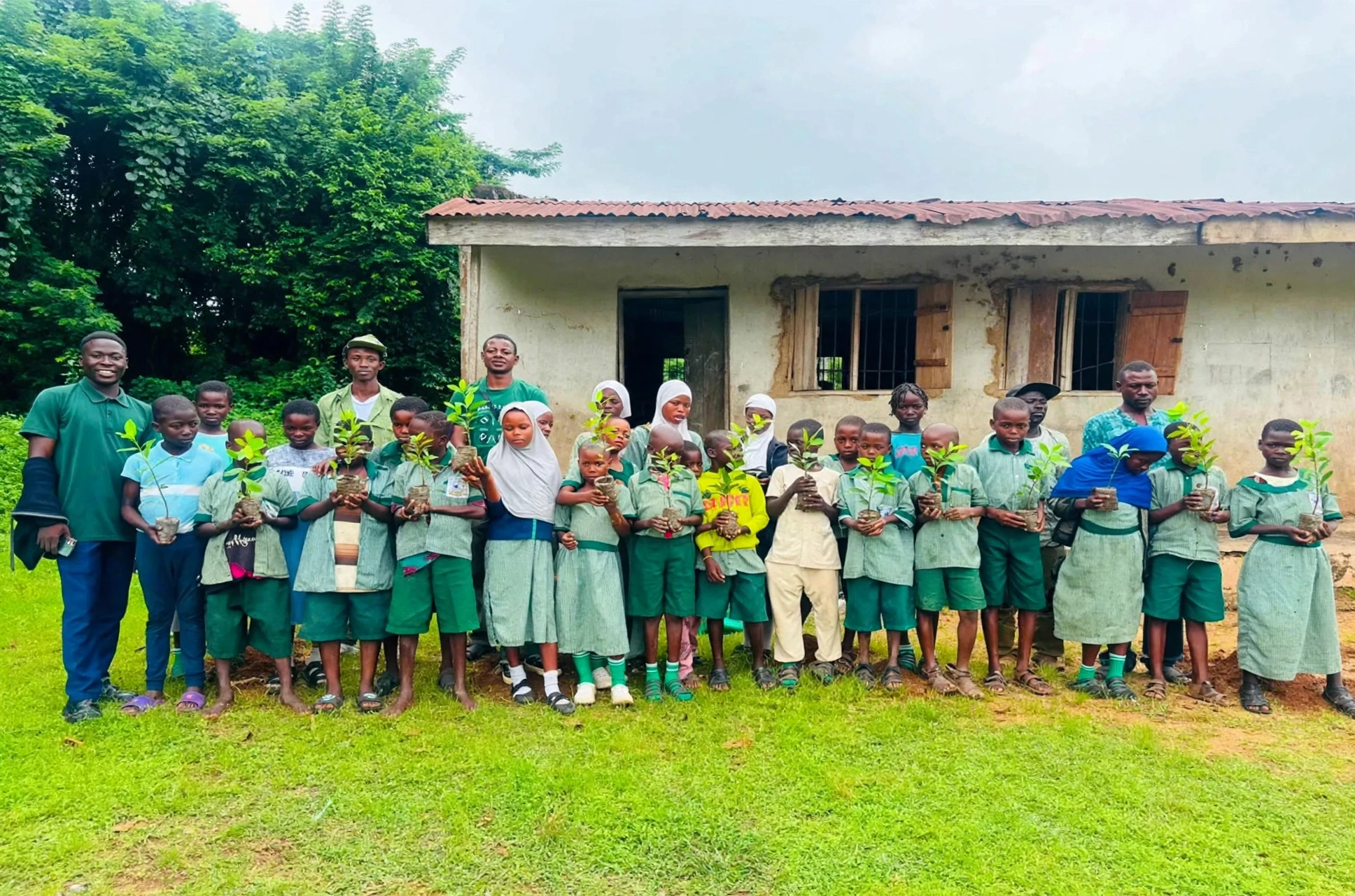
At BAGSfarm, we believe agriculture is more than learning how to grow food. A school garden can become a living classroom where children practice responsibility, communication, teamwork, problem-solving, and care for their community.
During the second term of our 4-H Youth Club at Apapa Odan Community Primary School, we combined practical school-garden activities with youth leadership lessons. We then measured what pupils learned through matched pre-assessments and post-assessments in two areas: leadership and school-garden/agricultural knowledge.
The results are encouraging — and they give us strong reason to keep growing this work.
At a glance
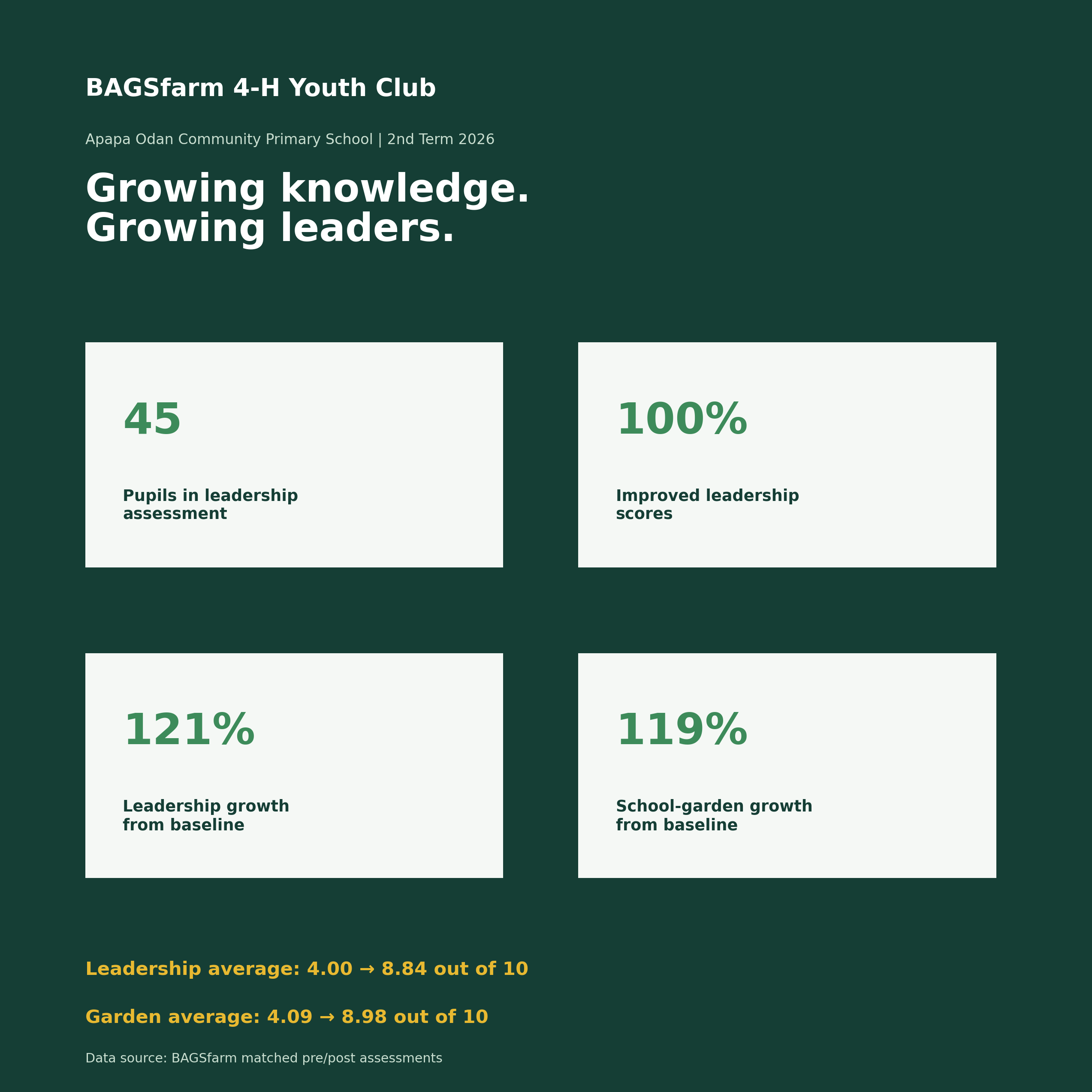
- 45 pupils participated, from Basic 2 through Basic 6 — 26 boys and 19 girls.
- Every pupil who completed the leadership pre- and post-assessments improved.
- Every pupil who completed both school-garden assessments improved.
- Average leadership scores rose from 4.00 to 8.84 out of 10.
- Average school-garden scores rose from 4.09 to 8.98 out of 10.
Building leadership through hands-on learning
Leadership is not only about speaking in front of a group. For young people, it also means learning to work with others, show respect, listen carefully, take responsibility, and contribute to a shared task.
At the beginning of the term, pupils' average leadership score was 4.00 out of 10. By the end of the term, the average had reached 8.84 out of 10 — an average increase of 4.84 points, or 121.1% relative to the starting average.
All 45 pupils who completed both leadership assessments showed an increase. In addition, 16 pupils achieved a perfect leadership score of 10 out of 10 at the end of the term.
These results suggest that pairing leadership lessons with practical group activities can help children understand and apply core leadership ideas.
Growing agricultural literacy in the school garden
The school garden gave pupils an opportunity to learn agriculture by doing: observing plants, discussing garden care, and connecting food production with everyday life.
Among the 43 pupils with complete school-garden pre- and post-assessment scores, the average increased from 4.09 to 8.98 out of 10 — an average gain of 4.88 points, or 119.3% relative to the starting average.
All 43 pupils with complete garden-assessment data improved, and 20 pupils reached a perfect 10 out of 10 on the post-assessment.
Two pupils were absent for the school-garden post-assessment. Their results were not included in the school-garden pre/post average so that the comparison remains fair.
Impact for girls and boys
One of our priorities is ensuring that both girls and boys can benefit from agricultural learning and leadership development.
In leadership, both groups began with the same average score: 4.00 out of 10. By the end of the term, boys averaged 8.96 and girls averaged 8.68 — both groups reaching strong post-assessment results.
In school-garden knowledge, girls began with a slightly higher average score (4.47) than boys (3.73). At the end of the term, the two groups were nearly equal: girls averaged 9.05 and boys averaged 8.92. This is an encouraging indication that the program created meaningful learning opportunities for pupils of all genders.
Why the results matter
For BAGSfarm, this work is about more than test scores. The scores help us check whether our lessons are reaching pupils and identify where we can improve. The garden provides a practical setting for children to ask questions, cooperate with peers, take ownership of tasks, and see the results of their effort over time.
The findings from this term strengthen our commitment to a simple idea: when children learn through agriculture, they can gain knowledge that reaches beyond the garden.
What comes next
We are proud of the progress made by the pupils, volunteers, teachers, and school partners at Apapa Odan Community Primary School. Our next step is to strengthen the evaluation of the program by working with a comparison school in a neighboring community. Both schools will complete the same pre- and post-assessments, helping us better understand the contribution of the BAGSfarm school-garden and leadership model.
We will also continue improving our curriculum, supporting teachers, and creating more opportunities for rural children to learn agriculture, leadership, and life skills through practical experience.
Growing food. Growing confidence. Growing the next generation of leaders.